

ATA No. 20260041
Help your child close maths gaps and start learning ahead of school.
An earlier gap may be making today’s work harder. A teacher-reviewed diagnostic helps find where to start.
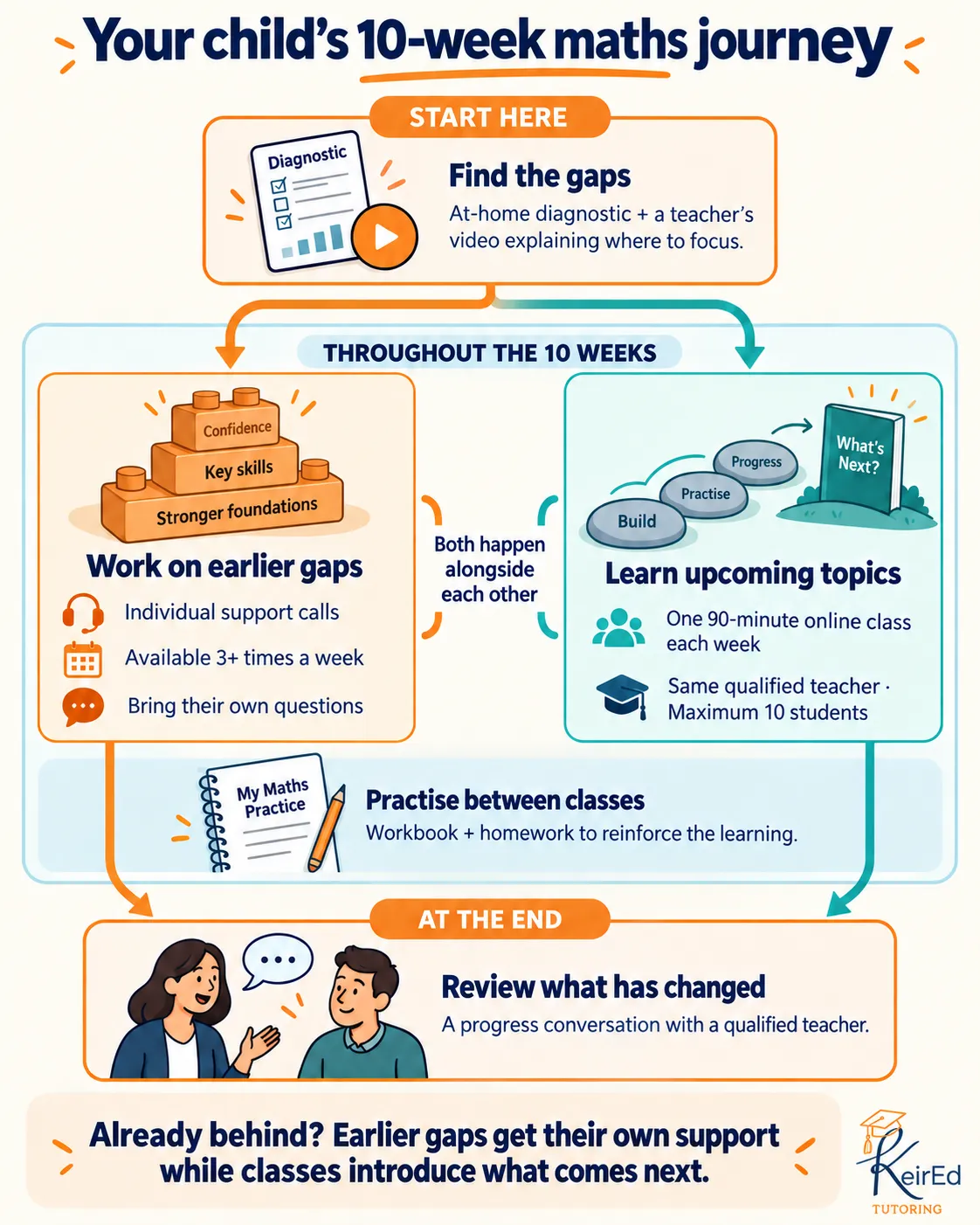
Over 10 weeks, individual support works on those gaps while weekly classes introduce upcoming school topics—so your child has a chance to meet new work with more confidence.
See how the two work together in the slides below.
Tell us a little about your child, then choose a time for a free 45-minute call.
A clear starting point.
Support for what comes next.
Earlier gaps get their own support, while weekly classes introduce what comes next at school.
Find where to start.
An at-home diagnostic, reviewed by a qualified teacher. You receive a video explaining the gaps and where to focus.
Learn upcoming school topics.
One 90-minute online class each week, with the same qualified teacher and no more than 10 students.
Give earlier gaps their own time.
Individual support calls are available 3+ times a week. Your child can bring questions and work on what they have missed.
Practise, then review progress.
A workbook and homework reinforce learning. At the end of 10 weeks, discuss what has changed with a qualified teacher.
See what KeirEd families say
STILL NOT SURE?
Frequently Asked Questions
What is the 10-Week Maths Program?
It is a ten-week program of live online maths classes and individual support for students in Years 7 to 12.
Your child has one 90-minute class each week with the same qualified Australian teacher, in a group of no more than ten, covering upcoming school topics.
Support calls run three or more times a week. Your child can also post questions in the community, with replies the same day or next business day.
The program starts with a diagnostic and ends with a progress conversation with a qualified teacher.
Who is it for?
Students in Years 7 to 12, anywhere in Australia.
Parents come to us for different reasons:
1. a child who has fallen behind and nobody has found where
2. a child who is coping now but losing ground each term
3. a child who is doing fine and could be in front
4. or a house where homework has turned into a nightly argument.
The program is built to cover all of those at once, which is why we work out which one is yours on the first call.
What does "a term ahead" mean?
The classes introduce topics your child’s school is likely to cover next term. In Term 4, that includes content for the following year. School topic sequences vary, so we discuss the right class for your child.
The benefit of starting before a topic reaches school is simple: your child gets another opportunity to understand it before meeting it in class.
If you are already thinking about next term or the move into a new year level, the call helps you check the class timing and whether it matches what your child needs.
Earlier gaps still get their own attention through individual support; your child does not have to have everything mastered before we discuss a starting point.
Is it all online?
Yes.
The classes, the 1:1 support calls and the community all run online, so it does not matter where in Australia you are.
Who teaches the classes?
Qualified Australian teachers.
The teacher who runs your child's class runs it for the whole ten weeks.
The 1:1 support on the calls and in the community also comes from qualified teachers.
How does the diagnostic test work?
Before the first class, your child sits a test at home.
It covers the years underneath the one they are in, because that is where the gaps usually are.
A qualified teacher marks it and sends you a video walking through what it found, so you see where your child's maths broke before the first class.
What happens between classes?
This is the 1:1 support.
Support calls run three or more times a week, and your child joins whichever one is next with their own questions, which a qualified teacher answers one to one.
There is also a private community, open every day, where questions are answered the same day or the next business day.
You get your own parent calls as well.
How many students are in a class?
Ten at most.
When a class has ten students we close it and open the next one.
Who is behind this?
KeirEd is based in Brisbane and has worked with more than 300 families across Australia since 2025.
The reviews on this page are from some of them.
What happens on the first call?
The call is free and lasts 45 minutes.
We ask about your child, what is happening in maths at school, and what you want to be different.
We explain the program, class availability and fees, and discuss whether it suits your child.
If we do not think it is the right fit, we say so.
What does a normal week look like?
One live 90-minute class with the same teacher, plus workbook practice and homework between classes.
Support calls run three or more times a week. Your child can bring questions to an available call or post in the community for a reply the same day or next business day.
We confirm the class time before enrolment. Allow time for practice and any support calls your child needs.
When do we start?
New blocks start through the year, including holiday programs.
If a block is about to start, your child starts with it.
If one is already running, they start the Monday after you book and pay for part of the program.
When will we notice a difference?
The first change comes from the class.
When the school reaches a topic, your child has already been taught it, so the new work stops being the problem.
The gaps from earlier years take longer, and they are worked on across the ten weeks on the 1:1 support calls.
At the end of the ten weeks you sit down with a qualified teacher and go through what changed, with the diagnostic test as the starting point.
What do I see as the parent?
The video from the diagnostic test before the first class, so you know what the gaps are.
Your own parent calls during the block.
Access to the private community, so you can see what is being asked and answered.
And the sit-down at the end, where a qualified teacher goes through what changed.
My child is behind. How does a class that runs ahead help?
Two things run at once.
The class stops them losing more ground, because they see every new topic before the school teaches it.
The gaps from earlier years are fixed on the 1:1 support calls, where a qualified teacher works on your child's own questions.
Both run every week for the ten weeks.
My child will not do it.
If your child has stopped wanting to try, tell us what happens when maths comes up. We will discuss their willingness to join before you enrol.
If previous help has not made a lasting difference, that does not mean you chose badly or your child cannot learn. Getting through this week’s homework can leave an earlier gap untouched.
The diagnostic gives you and the teacher a specific starting point. Individual support then gives those gaps their own attention.
Your child will still need to attend, practise and ask for help. We will talk through whether that feels realistic for your family.
What about our schedule?
One live class a week is the only fixed slot.
The support calls run three or more times a week and your child joins whichever one is next, so there is nothing else to book.
If they miss a class, they can make it up in another class that week if there is room in it.
We are not tech people.
It runs in a web browser.
We send you a link, your child clicks it, and they are in the room.
There is nothing to install and nothing to set up.
Why a group class and not one-on-one tutoring?
Your child may need help with two things at once: earlier gaps and the new topics school keeps introducing.
Our weekly class introduces upcoming topics, with the same teacher and no more than ten students. Individual support gives your child time to bring their own questions and work on earlier gaps.
That is the difference to look for when comparing options: does the support give both jobs their own time?
The aim is for your child to build stronger foundations while becoming more familiar with the work ahead. On the call, we will discuss whether this combination suits them.
What does it cost, and can we pay it off?
$1,995 for the full ten weeks, including GST, paid upfront.
If you need to split it, ask us on the call and we will tell you straight away what we can do.
If you join a block partway through, you pay for the classes that are left, not the full ten weeks.
How do we know it is right for our child before we pay?
That is what the first call is for.
We would rather tell you it is not a fit than take $1,995 from a family it will not help.
If we say yes, it is because we think it will work for your child, and the diagnostic test and the video give you the starting point before the first class.
What do we do now?
Tell us a little about your child in the form above, then choose a time for a free 45-minute call.
We will discuss whether the program suits your child and confirm class availability and the start date before enrolment.
Booking the call does not enrol your child in the program.
FOUNDERs
Jake and Leah
We help parents make sure their children have the skills and knowledge to improve their grades quickly and consistently.
We've helped 300+ students improve their grades and build their confidence in 2026 alone.
Qualified Teacher and Scientist
Australian Tutoring Association Registered
Actually give a damn

KeirEd Tutoring is a trading name of Elevate Group Australia Pty Ltd, ABN 92 689 858 231. 9 Dalgety St, Mount Gravatt East QLD 4122. [email protected].
This site is not a part of the Facebook website or Facebook Inc. Additionally, this site is not endorsed by Facebook in any way. Facebook is a trademark of Meta Platforms, Inc.